The Shift
The Tax Stamp Is Gone. Millions of New Suppressor Owners Have No Idea How to Train With One.
On January 1, 2026, the $200 NFA tax stamp on suppressors was eliminated — part of H.R.1 (the "One Big Beautiful Bill Act"), signed July 4, 2025. The ATF processed roughly 150,000 Form 4 applications on January 1 alone — a 5,900% spike over the normal daily volume of about 2,500. Suppressor ownership was already approaching 5 million units nationwide, nearly double the total from three years earlier. With the tax barrier gone, that number is accelerating.
Here's the problem nobody is solving: the internet is drowning in content about which suppressor to buy. Every gun blog, every YouTube channel, every manufacturer has a "best suppressors of 2026" listicle. What nobody is writing — and what millions of new owners actually need — is how to train with one.
Because a suppressor changes more than the noise level. It changes your gas system, your point of impact, your cleaning schedule, your weapon handling, and your training approach. If you bolt a can onto your rifle and go to the range without understanding what changed, you're going to have a bad day and form bad habits that cost you time and money to fix later.
This article is about the training side. What actually changes when you add a suppressor, what to prepare for, and how to build a suppressed shooting practice that accounts for the mechanical reality.
Everyone tells you which suppressor to buy. Nobody tells you how to train with one. That's the gap this article fills.
The Reality
A Suppressor Is Not a Silencer. It's a Muzzle Device That Changes Everything Downstream.
Start by killing the Hollywood myth. A suppressor does not make your gun silent. It reduces the report by 20–35 decibels — roughly the same reduction as a good set of earplugs. A suppressed 5.56 NATO rifle still registers 130–135 dB at the shooter's ear. OSHA's threshold for hearing damage from impulse noise is 140 dB. You are still in the range where cumulative exposure causes permanent hearing loss. You still need ear protection. Period.
That said, a suppressor does real, meaningful things — just not the thing most people expect. Here's the actual list:
What a suppressor does:
What a suppressor does NOT do:
- × Make your gun hearing-safe on most rifle calibers. You still need ear protection.
- × Eliminate the supersonic crack of the bullet. That's a function of bullet velocity, not the suppressor. Unless you're shooting subsonic ammunition, anyone downrange still hears the crack.
- × Work the same across all platforms. Bolt-action, semi-auto, and pistol are completely different suppressed shooting experiences with completely different training considerations.
This distinction matters because most new owners expect "quiet" and get "quieter but mechanically different." Training with a suppressor means training for those mechanical differences — not just enjoying the reduced noise.
The Problem
Your Eyes Are Going to Burn. Here's Why, and How to Fix It.
This is the section that separates surface-level suppressor content from genuinely useful information. If you shoot a gas-operated semi-automatic — an AR-15, AR-10, MCX, SCAR, or any platform that uses a gas tube or piston to cycle the action — a suppressor will push gas backward into your face. This is not a possibility. It is a certainty on an un-tuned gun.
Here's the mechanics: a suppressor traps gas that would normally exit the muzzle. That gas remains at elevated pressure longer than it would without the suppressor. On a gas-operated semi-auto, the gas system is tapped off the barrel and routed back into the action to cycle the bolt. With a suppressor, the increased backpressure sends more gas, at higher pressure, for longer back through the gas tube, into the receiver, out the ejection port and charging handle seams, and directly into the shooter's face.
The result is a cloud of aerosolized carbon, primer residue, and unburned powder that stings your eyes, coats your shooting glasses, and — with prolonged exposure — poses legitimate health concerns. On an un-tuned AR-15 with a suppressor, sustained fire produces enough blowback to make your eyes water within one magazine. Competitive shooters and high-volume trainers report eye irritation, headaches, and nausea from extended suppressed sessions. The military has studied this. It's a real issue, not a minor inconvenience.
Three ways to fix it:
Bolt-action rifles: None of this applies. No gas system means no blowback. This is why bolt-action precision rifles are the easiest platform to shoot suppressed — add the can, re-zero, and shoot. If you're new to suppressors and want the simplest possible entry point, a bolt gun is it.
Pistols: Suppressed pistols have their own quirk. Many semi-automatic pistols need a Nielsen device (recoil booster) built into the suppressor piston to cycle reliably with the added weight at the muzzle. If your suppressed pistol is short-stroking or failing to lock back, this is usually why. Check that your suppressor uses the correct piston for your pistol's thread pitch.

The Technical
Your Rifle Was Zeroed Without the Can. Now Your Zero Is Wrong.
Adding a suppressor shifts your point of impact. Not might. Does. The question is how much and in what direction.
Why it happens: the suppressor adds weight to the muzzle end of your barrel, which changes barrel harmonics — the way the barrel flexes and whips during the firing cycle. As a barrel fires, it doesn't remain perfectly straight. It oscillates in a consistent pattern, and the bullet exits the bore at whatever angle the muzzle is at when the bullet passes through. Add weight to the muzzle and you change that oscillation pattern. The bullet now exits at a slightly different angle. That angle difference translates to a point-of-impact shift at distance.
Typical shift is 1–3 inches at 100 yards. Some rifle-suppressor combinations shift as much as 10–12 inches at 100 yards — especially with lightweight barrels and heavy suppressors. The shift is usually consistent and repeatable, which is the good news. It moves to the same place every time you mount the suppressor.
Key practical points:
Get the Suppressed Shooting Guide
Enter your email and we'll send you a printable one-pager covering gas system tuning, POI shift management, heat safety, cleaning cadence, and range etiquette for suppressed shooting.
The Practical
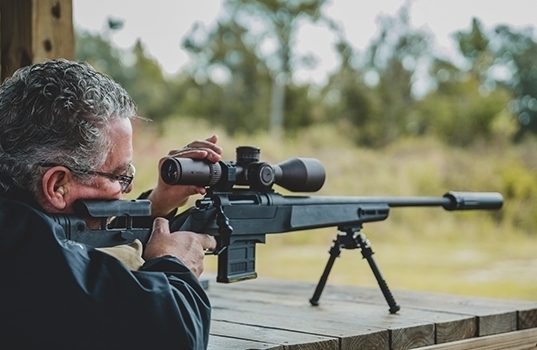
It Gets Hot. It's Longer. It Changes How You Handle the Gun.
The stuff experienced suppressed shooters know that new owners don't — and that nobody puts in the listicles:
At the Range
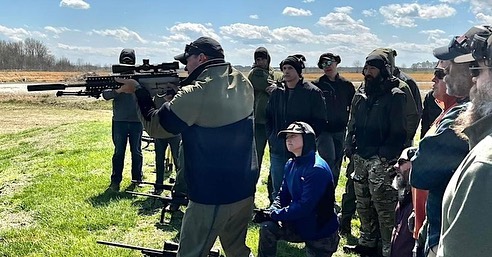
Can You Just Show Up to a Class With a Can? It Depends.
Call the range or school first. Not all ranges allow suppressors. Some have specific rules about which lanes or bays permit them. Indoor ranges may have restrictions based on ventilation capacity. Don't assume.
Not every instructor has experience teaching suppressed. If you're taking a general carbine class and want to run suppressed, ask the instructor beforehand if they're comfortable coaching through the gas and handling differences. A good instructor will adjust; some have never dealt with a suppressed student and won't know what to tell you when your eyes start watering.
Your suppressor is a courtesy to the line. The one unambiguous positive: other students benefit from your suppressor. The reduced blast and concussion make the shooting environment more comfortable for everyone — especially in a class with 10-15 people on a crowded line. Some instructors actively encourage suppressors for this reason.
If a school offers a dedicated suppressor course, take it. You'll learn more in 8 hours with a suppressor-specific instructor than in a year of figuring it out at the range by yourself. These courses are still rare — but they exist, and they cover gas tuning, zeroing, maintenance, and suppressed-specific drills that a general carbine course won't touch.
The Law
The Tax Is Gone. The Paperwork Isn't. And 8 States Still Say No.
The $200 NFA tax stamp was eliminated effective January 1, 2026, as part of H.R.1. But the NFA process itself — Form 4, background check, fingerprints, photographs, and dealer transfer through an FFL with SOT status — is still fully in place. You don't walk into a store and walk out with a suppressor. You file the form, submit biometrics, wait for ATF approval, and pick it up from your dealer. Processing times may increase substantially due to the demand surge.
8 states where suppressors are still illegal: California, Hawaii, Illinois, New York, New Jersey, Massachusetts, Rhode Island, and Delaware. Plus the District of Columbia. If you're in one of these states, this article doesn't apply to you yet — though the federal law change may put pressure on state legislatures over time.
42 states allow civilian ownership. Two caveats: Connecticut and Vermont allow ownership but prohibit suppressor use while hunting. Minnesota requires a separate local transfer permit from law enforcement before you can take possession, which adds time and a subjective approval step on top of the federal process.
The suppressor market is about to explode. The tax barrier is gone. Prices are dropping as manufacturers ramp production. Within a few years, running a suppressor on your carbine or your bolt gun will be as normal as running a red dot on your pistol. The trajectory is clear and the adoption curve is steep.
But a suppressor is not a bolt-on upgrade that requires zero adaptation. It changes your gas system, your zero, your cleaning schedule, your weapon handling, and your range etiquette. The people who treat it as "just a quieter gun" are the ones who show up to the range with burning eyes, a shifted zero, and a filthy bolt carrier group wondering what went wrong. Train for the mechanical reality. Adjust your gas system. Re-zero for your configuration. Plan for heat. Clean more often. And if a school near you offers a dedicated suppressor course — take it. The discipline is new, the instructors who specialize in it are still rare, and the information you'll get in a single day is worth far more than the tuition.
Related Reading
First Timer's Field Manual
Your First Carbine Class: What to Expect, What to Bring
The platform most people suppress first. Build the carbine foundation before adding the can.
Decision Guide
Precision Rifle for Beginners: Why the Class Costs $800
Bolt-action is the easiest platform to suppress. No gas issues, just re-zero and shoot.
Training Intel Brief · Data Report
What Tactical Training Actually Costs in 2026
Full pricing context across all course types — plan your training budget.