The Case
You Train to Shoot. Do You Train to Save a Life?
Every other article on this site teaches you how to put rounds on target. This one teaches you what to do when someone — or you — is bleeding out and EMS is ten minutes away.
The uncomfortable truth: in a mass casualty event, a car accident, an industrial accident, or a range incident, the person most likely to save a life is not a paramedic. It's the bystander who got there first. A severed femoral artery can kill in under five minutes. Average EMS response time in the United States is eight to fourteen minutes. The math is simple and the gap is lethal.
That's the premise behind tactical medical training for civilians: give ordinary people the skills to control life-threatening bleeding in the minutes before professional help arrives. It's the cheapest, shortest, most universally applicable training in our entire database — and it's the one most people skip because they assume it's "for medics."
It's not. It's for you. It's for the parent in the school parking lot. The coworker in the warehouse. The bystander at the intersection. The shooter on the range when someone has a negligent discharge. None of these people are medics. All of them are close enough to make the difference.
Tactical medical training is not for medics. It's for the person who's already there when the bleeding starts.
The Landscape
Three Levels of Training, One Goal: Keep Someone Alive Until Help Arrives
The tactical medical training world has three tiers. They all teach the same core skills — hemorrhage control, airway management, casualty assessment — at different depths. Here's how they compare:
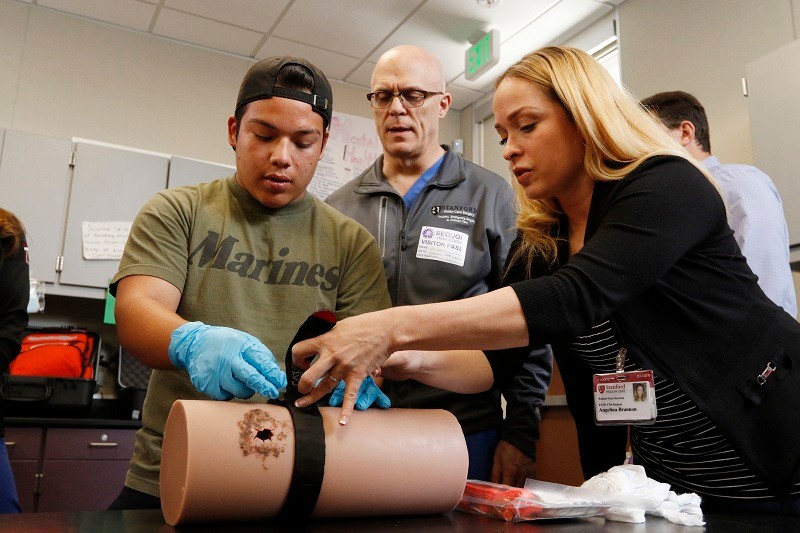
The entry point. Created by the American College of Surgeons after Sandy Hook. Over 5 million people trained worldwide. You learn three skills: apply direct pressure, pack a wound, apply a tourniquet. That's it. Ninety minutes, hands-on practice on manikins, and you leave knowing how to control life-threatening bleeding. No medical background needed. No prerequisites. If you've never taken any medical training, start here.
The civilian translation of military trauma medicine. Developed by the Committee for Tactical Emergency Casualty Care (C-TECC) in 2011, TECC takes the battlefield lessons from TCCC and adapts them for civilian first responders, law enforcement, and prepared citizens. Structured around three phases: Direct Threat Care (what to do while the threat is still active), Indirect Threat Care (threat neutralized but scene not fully secure), and Evacuation Care (preparing the casualty for transport). You'll practice tourniquet application, wound packing, chest seals, airway management, and casualty movement under stress. More hands-on and scenario-driven than Stop the Bleed.
The military origin. Developed by the Department of Defense for battlefield trauma care. Three tiers: TCCC-ASM (All Service Members, 7 hours), TCCC-CLS (Combat Lifesaver, 40 hours), and TCCC-CMC/CPP (medical personnel, 63–68 hours). Some civilian training providers offer the ASM curriculum to prepared citizens. The content overlaps heavily with TECC but uses military terminology and assumes a combat context. If you're a civilian, TECC is usually the better fit — but either will teach you the skills that matter.
The bottom line: Stop the Bleed is the 90-minute version. TECC is the full-day deep dive. TCCC is the military original. All three teach the same core skills at different depths. Start with Stop the Bleed. Progress to TECC when you're ready for scenarios and stress.
The Skills
Tourniquets, Wound Packing, Chest Seals — and Why You Practice Until It's Muscle Memory
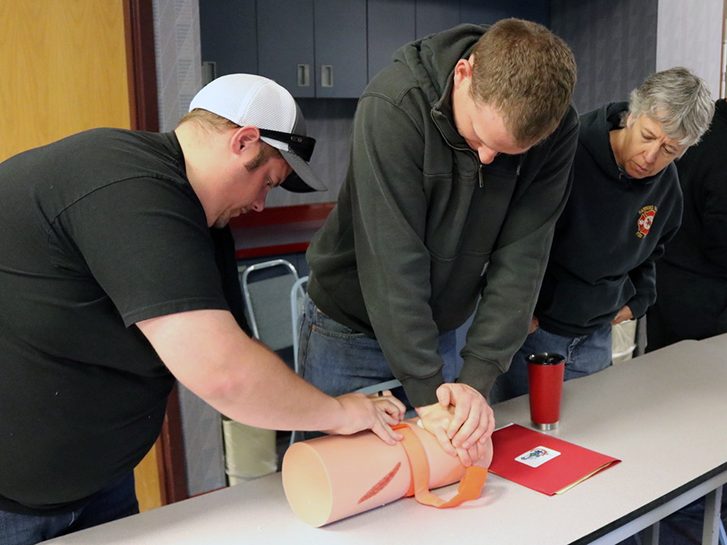
The core of every tactical medical course is hands-on practice. You don't learn this from a PowerPoint. You learn it by doing it wrong six times and then doing it right. Here are the specific skills you'll train:
Get the Tactical Medical Training Guide
Enter your email and we'll send you a printable one-pager comparing Stop the Bleed vs. TECC vs. TCCC — what each teaches, what it costs, and where to find courses near you.
The Investment
The Cheapest Life-Saving Training You'll Ever Take
Median tactical medical course: $250. Stop the Bleed classes are often free. The entry-level version of this training costs less than lunch.
The range is enormous, but the entry point is as accessible as training gets:
- Free Stop the Bleed — many hospitals, fire departments, and community organizations offer free classes. The American College of Surgeons designed the program to be accessible.
- $200–$500 TECC courses — full-day or two-day courses with hands-on scenarios and stress inoculation.
- $500–$1,250 Advanced / specialized — multi-day courses, wilderness medicine, prolonged field care.
For context: a pistol course costs $225 median. A precision rifle course costs $650. A force-on-force course costs $500. Tactical medical training — the one that might literally save a life — costs less than any of them. And the entry-level version is free.
Availability
Where to Find Courses
Tactical Course Directory tracks tactical medical courses across dozens of organizations in 15+ states. But the real entry point is Stop the Bleed — and those courses are everywhere. Your local hospital, fire department, or Red Cross chapter likely offers them, often at no cost. Visit stopthebleed.org to find a class near you.
For TECC and more advanced tactical medical training, browse our directory. Top states for availability include New York, Nevada, Utah, Texas, and Ohio. Many organizations that teach firearms courses also offer medical training — it's increasingly common to see schools bundling a Stop the Bleed or TECC module into their multi-day course packages.
You train to shoot, you train to move, you train to make decisions under stress. Train to stop someone from bleeding to death. It's 90 minutes, it's often free, and it's the one class on this entire site that applies whether you own a gun or not. Find a Stop the Bleed class this month. Then come back and take a TECC course when you're ready for the next level.
Related Reading
Decision Guide
Force-on-Force for Civilians
FoF courses often include medical scenarios. Know how to treat a casualty, not just cause one.
Decision Guide
CCW Beyond the Permit: The Training to Take After Your Permit Class
Medical training belongs in the CCW progression. Here's where it fits.
Training Intel Brief · Data Report
What Tactical Training Actually Costs in 2026
Full pricing context across all course types — see where medical fits.