The Trend
Red Dots on Pistols Aren't Optional Anymore. Here's How to Train the Transition.
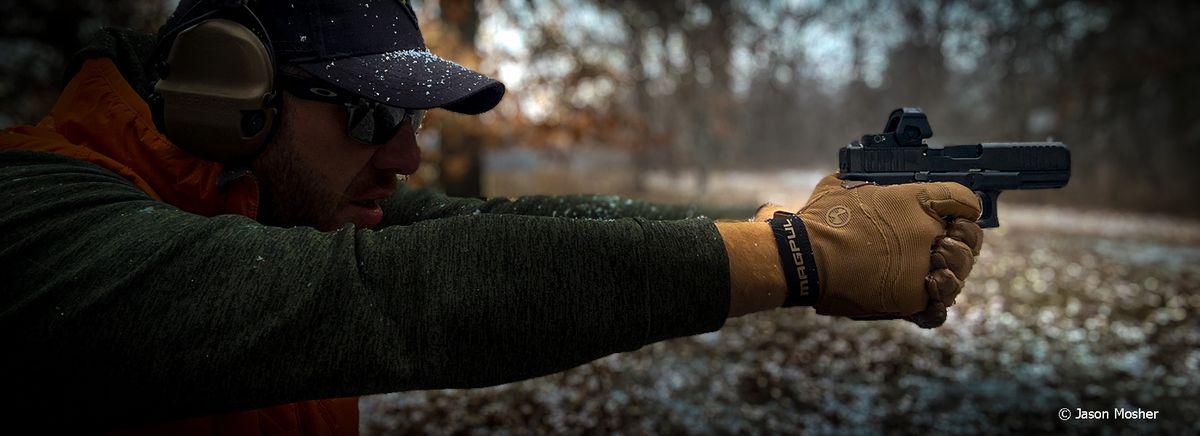
Pistol-mounted red dots have gone from competition novelty to factory standard. In 2026, nearly every major manufacturer ships optic-ready pistols — Glock MOS, Sig P320 and P365 with optic cuts, Smith & Wesson M&P Optics Ready, Springfield Echelon, CZ P-10 OR. Instructors across the industry report that red dot transition is the single biggest equipment trend they're seeing in classes.
The problem: most people buy the optic, mount it, go to the range, and immediately can't find the dot. Their groups open up, their draw time gets slower, and they wonder if they wasted $300. They didn't — they just skipped the training step that makes the optic work.
This article is about that training step. What changes when you add a red dot, why the transition is harder than it looks, what dedicated optic courses teach, and whether you need a formal class or can train the transition yourself. Our database includes 95 courses that specifically address pistol optics — dedicated red dot classes at schools like Gunsite Academy, Valortec, Manzano Tactical, Firearms Training Associates, and LifeSafe Training. The category is growing fast.
The Physics
It's Not Just a Better Sight Picture. Everything About Your Presentation Changes.
Adding a red dot to your pistol changes more than the sight picture. It changes your draw, your visual focus, your grip feedback loop, and how you track the gun through recoil. Here's what's actually different:
The Fix
Every New Red Dot Shooter Has This Problem. Here's the Drill That Solves It.
"I can't find the dot." It's the universal complaint from people transitioning to a pistol red dot. The dot isn't there when they present the gun. Here's why it happens and what to do about it.
Why it happens: Your presentation — the path the gun takes from holster to full extension — was built around iron sights. Iron sights are forgiving because the rear notch captures the front sight across a wide range of angles. A red dot window is small and the dot only appears when your eye, the optic, and the target are aligned precisely. Your old presentation gets you close enough for irons but not close enough for the dot.
High compressed ready to full extension. Straight out, not up in an arc. Lock your wrists. The dot should appear at the same point in the stroke every time. Dryfire. Hundreds of reps. Then thousands.
Start with the gun at high compressed ready — both hands on the gun, tucked to your chest. Drive the gun straight out to full extension. The dot should appear in the window as the gun reaches your eye line. Do this in dryfire. Pick a specific point on the wall — a light switch, a nail head — and present to it. The dot should appear at the same point in the stroke every time without searching.
Key coaching points: Drive the gun straight out, not up in an arc. Lock your wrists — wrist flex is the number one dot-killer. If you're "fishing" for the dot at full extension, your presentation has a variable. Find it and fix it. This drill is what dedicated red dot classes spend most of their time on. It's also something you can practice entirely in dryfire, at home, for free.
Get the Red Dot Transition Guide
Enter your email and we'll send you a printable one-pager with the presentation drill, the coaching points, and what to look for in a dedicated optic course.
The Question
Dedicated Course vs. Self-Study: When a Class Is Worth the Money
Self-study works if: you have a solid pistol foundation, you're disciplined about dryfire, and you can honestly diagnose your own presentation issues. The core transition drill is free to practice. Many experienced shooters transition successfully with two to three weeks of daily dryfire and a few range sessions.
A dedicated class is worth it if: you're new enough to pistol shooting that you're building presentation habits for the first time (better to build them around the optic from the start), you've been trying to self-transition and the dot still isn't consistently appearing, or you want structured feedback from an instructor who can see what you can't. A good red dot class will diagnose your specific presentation issues in the first hour.
Dedicated red dot pistol courses typically run $200–$400 for a one-day class. Several schools in our database offer them — Gunsite Academy (AZ), Valortec (FL), Manzano Tactical (CA), LifeSafe Training (CT), Firearms Training Associates (CA), among others. Many schools also now incorporate red dot skills into their standard pistol courses — if your gun has a dot, a good instructor will work with you on it regardless of the course title.
The Reality Check
Why You Should Keep Training Irons Even After You Switch
The red dot is your primary sighting system now. But iron sights aren't retired — they're your fallback. Batteries die. Lenses crack. Electronics fail at the worst possible moment. Suppressor-height co-witness irons are there for exactly this reason.
Beyond backup duty, iron sights serve as a diagnostic tool. Shooting irons periodically confirms your fundamentals haven't degraded — the red dot can mask grip issues and trigger press errors that iron sights immediately expose. Some courses and competitions still require or prefer iron sights. And the mechanical presentation skills you built on irons are the exact foundation that makes the red dot transition possible.
The best red dot shooters are also competent iron-sight shooters. Don't abandon irons. Add the dot as your primary system and keep the irons as your fallback, your fundamentals check, and your training baseline.
The red dot is the future of defensive pistol shooting. Factory optic-ready pistols are the norm, not the exception. The transition takes work — your draw changes, your visual focus changes, and the dot punishes every inconsistency in your presentation. But once the transition clicks, you'll shoot faster, more accurately, and with better situational awareness than you ever could with irons. Start with dryfire. If you stall, take a class. And keep your iron-sight skills sharp — they're the foundation everything else rests on.
Related Reading
First Timer's Field Manual
Your First Pistol Course: What to Expect, What to Bring
Build the foundation before you add the optic. Iron-sight fundamentals are what make the transition possible.
Training Intelligence · Quality Framework
What Good Training Actually Looks Like
The quality signals to watch for in any class — whether it's a dedicated optic course or a general pistol class.
Training Intel Brief · Data Report
What Tactical Training Actually Costs in 2026
Full pricing context across all course types — where red dot classes fit in the cost spectrum.